
Your cart
Your cart is empty
Join us



Company News
Our Malts
New Hops

Our Yeasts
Our Spices


Beer recipe - Non-Alcoholic IPA
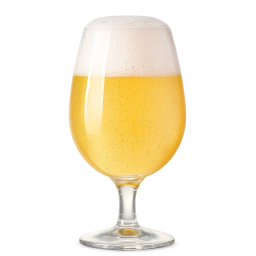
| ABV 0.3–0.4% | Color 5.4 EBC | Bitterness 20 IBU |
Description
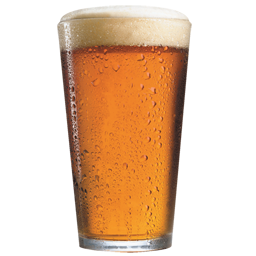
A refreshing, light-colored beer with mild bitterness, dominated by citrus and tropical fruit notes. This recipe provides a base for designing non-alcoholic beers (alc. < 0.5% vol.). The malt quantity can be slightly adjusted depending on the actual brewhouse efficiency achieved in your brewery. The hop variety can also be replaced depending on the desired aroma profile.
A refreshing, light-colored beer with mild bitterness, dominated by citrus and tropical fruit notes. This recipe provides a base for designing non-alcoholic beers (alc. < 0.5% vol.). The malt quantity can be slightly adjusted depending on the actual brewhouse efficiency achieved in your brewery. The hop variety can also be replaced depending on the desired aroma profile.
Service:
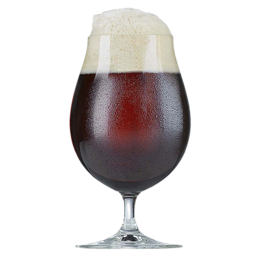
Glass: Tulip Glass
Temperature: 4 °C
Glass: Tulip Glass
Temperature: 4 °C
BREWER`S TIPS
For a maltier version of this IPA, feel free to replace Château Pilsen malt with Château Pale Ale or even Château Munich Light.
For a maltier version of this IPA, feel free to replace Château Pilsen malt with Château Pale Ale or even Château Munich Light.
RECIPE FOR 100L
MALT
| Château Pilsen 2RS | 90% / 5.85 kg |
| Château Cara Clair | 10% / 0.65 kg |
HOPS
| Citra (12.0% aa) | 20.0 IBU / 350 g |
YEAST
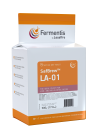
| SafBrew LA-01 | 50 g |
Mashing temperature
Step 1: Mashing
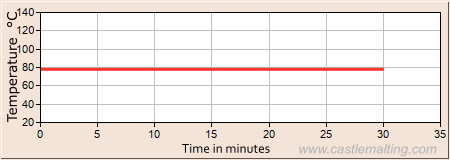
Mash-in and follow the profile below:
Mash-in and follow the profile below:
| pH | 5.4 | Mix Ratio | 2.7 L/kg |
Mash in at 78°C
Rest for 30 min at 78°C
Once mashing is complete, lauter and sparge with water at 78°C.
Rest for 30 min at 78°C
Once mashing is complete, lauter and sparge with water at 78°C.
Step 2: Boiling
Boil for 60 min.
Hop addition 1: At the beginning of the boil, add 50 g of Citra.
Perform a whirlpool to remove the trub.
Important: lower the pH to 4.2 (or even lower) before fermentation — or perform a “kettle souring.”
Boil for 60 min.
Hop addition 1: At the beginning of the boil, add 50 g of Citra.
Perform a whirlpool to remove the trub.
Important: lower the pH to 4.2 (or even lower) before fermentation — or perform a “kettle souring.”
| Total evap 6–8% | Batch size 100L | OG 5oP | Efficiency 75% |
Step 3: Fermentation and Maturation
Cool the wort to 20°C and pitch the yeast.
Allow fermentation at 20°C for 48 to 60 hours maximum!
Then quickly lower the temperature to 2°C. This will limit the risk of contamination.
For dry hopping, add 300 g of Citra, leave for 48 hours, then remove the hops. A temperature of 2°C is not optimal for dry hopping, but in this case it helps prevent hop creep.
Adjust the pH to reach 4.0–3.6.
Let rest for 3 days at 2°C. Remove the yeast and hop residues.
Cool the wort to 20°C and pitch the yeast.
Allow fermentation at 20°C for 48 to 60 hours maximum!
Then quickly lower the temperature to 2°C. This will limit the risk of contamination.
For dry hopping, add 300 g of Citra, leave for 48 hours, then remove the hops. A temperature of 2°C is not optimal for dry hopping, but in this case it helps prevent hop creep.
Adjust the pH to reach 4.0–3.6.
Let rest for 3 days at 2°C. Remove the yeast and hop residues.
| Attenuation | 13–17% | FG | 4.15–4.35oP |
Step 4: Cold Aging and Packaging
Keep the beer for 2 days at 2°C, remove the remaining yeast, and bottle the beer.
Since the beer still contains a high amount of residual fermentable sugars at the end of fermentation, it is mandatory to pasteurize the beer after bottling (between 80 and 120 PU).
Keep the beer for 2 days at 2°C, remove the remaining yeast, and bottle the beer.
Since the beer still contains a high amount of residual fermentable sugars at the end of fermentation, it is mandatory to pasteurize the beer after bottling (between 80 and 120 PU).
This recipe is provided by Castle Malting®. Please note that this recipe is just a guideline. Some modification might need to be done to meet different technologies, efficiencies and ingredients yield as grain dry extract and hop alpha acid percentage.
For further information & service please contact: info@castlemalting.com
Brewing is an experiment! Brew your own beer!
Send us your recipe, and we’ll be pleased to publish it on our website
For further information & service please contact: info@castlemalting.com
Brewing is an experiment! Brew your own beer!
Send us your recipe, and we’ll be pleased to publish it on our website